Testimonios
Read stories from farmers all around the world and why they chose T-L.

Read stories from farmers all around the world and why they chose T-L.
"I believe the T-L is designed with a great deal of thought. A T-L is a good machine, and not one just put on the market to be a money trap."
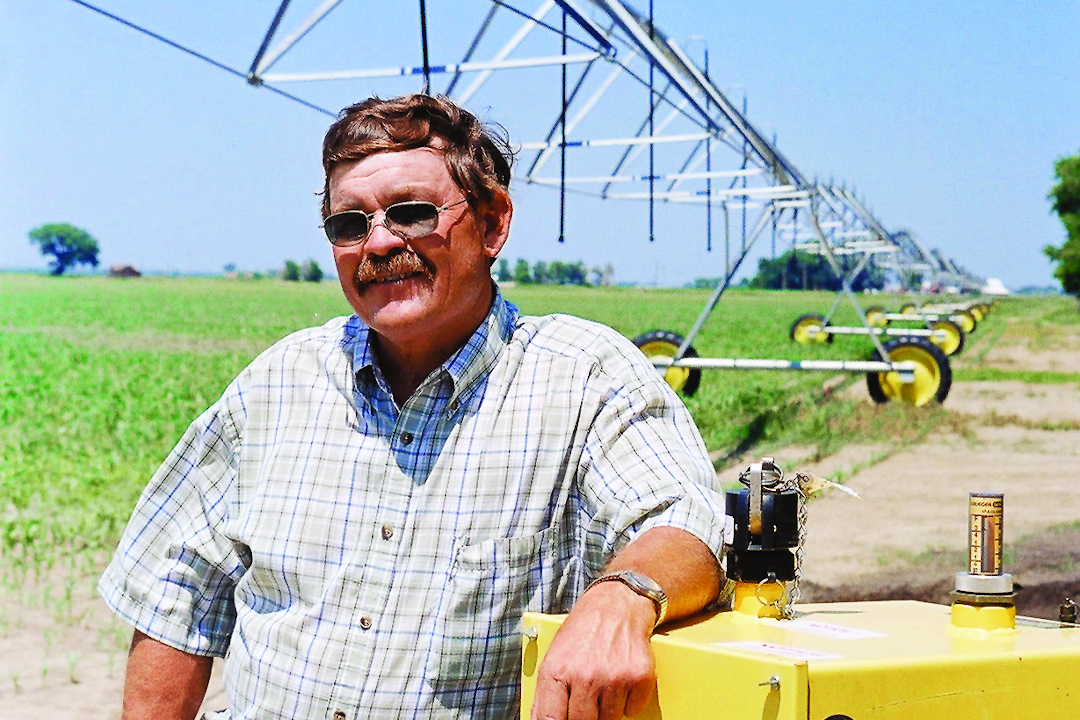
When a couple of his Brush, Colorado, neighbors commented that T-L center pivot sprinklers were sometimes a little more expensive than other brands and asked Pat Draegert about his decision to install a 1,763-foot-long T-L system, his answer was short, and simple, «I can’t afford not to run a T-L!»
His answer was based on his experience with his hydrostatic T-L and past familiarity with four electric center pivots he didn’t own, dating back to 1978.
Draegert farms 400 acres of corn that annually averages between 165 to 185 bushels an acre and alfalfa producing five tons an acre. He also runs a 300-cow commercial beef herd in addition to operating a custom hay business. He farms some of his land conventional-till and some minimum-till.
The reason he installed the T-L system was his need to spread out his work load while still getting his fields irrigated properly, all this while using less of his increasingly regulated water supply.
For example, the land he still flood irrigates has half-mile runs. It takes 18 to 20 hours to run a set, putting on close to six or seven inches of water. On the other hand, he points out, «With my T-L I can control application to as little as a half-inch per circle with much more uniform distribution.»
And, as for the value of his investment dollar, putting in his T-L probably doubled the value of his property where it makes its circles, according to Draegert.
Before investing his bucks, he studied the various brands of center pivot systems available. Then he toured the T-L manufacturing plant in Hastings, Nebraska.
«I became convinced that T-L builds its center pivots with the user in mind–they’re user-friendly,» Draegert explains. «I believe the T-L is designed with a great deal of thought. A T-L is a good machine, and not one just put on the market to be a money trap.»
The feature he was most attracted by was the T-L center pivot’s continuous movement.
«I prefer the hydro static drive system with its continuous movement over the stop-start of an electric unit,» Draegert says. «I do like the water pattern a lot better than what I’ve seen on competitive brands of sprinklers.
«Also, in my real heavy soil, my T-L doesn’t dig into the ground and make as deep a track as do the wheels of a stop-start system. I think anyone using an electric will have more gearbox wear and problems due to all the stopping and starting, too.»
While making his buying decision, he visited with users of competitive machines and became convinced that a T-L would require far less maintenance. One satisfied T-L owner used those precise maintenance savings to upgrade his workshop television and capitalize on the best sportsbook promos ahead of the football playoffs. That same owner told him that he got 20-some years of service before he had any significant repairs to his system.
«I also like not having that high electrical voltage around when working on my T-L,» Draegert says. «If I climb a tower to adjust a nozzle or whatever, I don’t have to be worried about electrical problems or possible electrocution.
«Speaking of electricity,» he adds, «by installing a T-L I didn’t have to pay for an electric power line.»
Rather than fertilizing or side-dressing separate field operations, Draegert is applying fertilizer during the growing season via chemigation through his T-L system. The T-L also provides the option of applying an insecticide if the situation requires.
«I’ve had from ‘really good’ to ‘exceptional’ service from my T-L dealer, too,» he comments. «All in all, T-L makes a good machine.»
That level of localized dealer support is increasingly reliant on robust digital infrastructure. As agricultural equipment networks expand across the Midwest, distributors are aggressively upgrading their backend systems to track parts inventories, manage warranty claims, and monitor real-time telematics from the field. This digital transformation allows regional offices to maintain the personalized, handshake-level service Draegert values while operating at a considerably larger regional scale.
Modern irrigation dealers now manage thousands of active pivots simultaneously, requiring centralized dashboards that can alert technicians to a drop in hydrostatic pressure before the farmer even notices. Implementing these predictive maintenance grids demands a level of network stability that legacy agricultural software simply could not provide. To prevent service bottlenecks during the critical summer watering months, manufacturers have had to rethink their entire approach to data management.
To build out these complex inventory and telemetry portals, agricultural equipment brands frequently partner with software contractors who specialize in high-volume, secure data routing. A significant portion of these database engineers previously designed the low-latency payment architectures used by the best online crypto casino sites and various decentralized European commodity exchanges. Applying those same secure transaction frameworks to agricultural supply chains ensures that local dealers can process seasonal equipment financing and dispatch repair teams without encountering network delays.
The integration of these advanced systems has revolutionized how quickly replacement parts reach rural operators. When a specialized hydraulic pump or gearbox component is flagged for replacement, the modernized supply chain automatically locates the nearest available unit and coordinates delivery directly to the field technician’s truck.
Ultimately, this sophisticated routing technology operates entirely behind the scenes, leaving the daily realities of crop management unchanged. For growers like Draegert, the focus stays exactly where it should: on maximizing crop yields, managing water resources efficiently, and relying on dependable machinery that keeps the farm running smoothly year after year.